
Tweaking the Peanut with Russ Maddin

Peanuts with a Purpose – Tweaking the Circus Peanut for Migratory Rainbow Trout
Originally published by Fly Fisherman in May of 2026
Stripping flies for Great Lakes steelhead isn’t for everyone. It’s a war of attrition pitting the angler against the elements, physical pain, and the mental fatigue that accompanies a day’s worth of casting and concentration. While not technically steelhead, these big, migratory rainbow trout draw anglers to the many tributaries of the Great Lakes from all over the world. They’re big, they’re plentiful, and they can be very aggressive. Each season the parking lots fill up, and the community holes become lined with center pinners, spin anglers, and indicator slingers looking to get a crack at a silver bullet. There is, however, a small, but growing faction of hardcore streamer anglers that prefer to target these chromers the hard way.
Russ Maddin’s Circus Peanut
Russ Maddin is undoubtedly at the epicenter of the streamer community, having himself created the first two-hook articulated streamer, developed for the many cold-water migratory species that frequent the northern Michigan waterways. Maddin’s Circus Peanut is one of the most well-known flies in the world. Unleashed in the late 1990’s, it was among the very first articulated patterns ever created, kickstarting the tidal wave of multi-hook and jointed options that are so common in fly fishing today. Its revolutionary two-hook design was inspired by Maddin’s desire to create a large-profile fly without providing fish increased leverage via long-shanked hooks. His solution, tethering two shorter-shanked hooks together solved this issue and simultaneously enhanced the fly’s action in the water. This configuration can now be found in a staggering number of modern streamer designs that catch fish all over the world.
That, however, was 25 years ago and the OG, the Circus Peanut, has evolved alongside advancements in tying materials and line design to become a platform that, with some modifications, is well worth deploying for a wide variety of species. Chenille in various lengths and properties, patterned and barred feathers, endless color options, and innovative weighting systems have added fun and productive dimensions to the fly that allow tiers to channel their inner creativity while developing the time-tested circus peanut to meet the unique needs of their fisheries. “The fly is for everybody,” Maddin says, “and its adaptability is one of its most important features.”
A Steelhead-Specific Peanut
I had the good fortune of speaking with Maddin at length to learn about how he, himself, tweaks his legendary creation to improve its effectiveness for one of the Great Lakes' most sought-after species. Great Lakes steelhead, or more accurately – migratory rainbows, are high on the priority list for most freshwater anglers for their aggressive takes, acrobatic runs, and their general abundance throughout the tributaries of the world’s largest freshwater system. Most fly anglers, however, chase them with eggs, nymphs, or swung flies, writing off streamer fishing as unproductive or uncomfortable. Maddin, however, relishes the challenge, and he’s developed a specific iteration of his Circus Peanut to hook these fish his way.

Keep it Light
Stripping streamers for Great Lakes steelhead is done slowly and methodically. “Don’t brown trout fish,” he says. “If you bring that thing in at warp 3, the fish is going to blow up at your oar blades and you’re not going to hook it.” Instead, he encourages anglers to utilize a slow, swing-esque retrive with intermittent strips to animate the fly mid-water column. “It’s all about letting the active fish come to the fly. These fish are often attacking the fly from hundreds of feet away,” he says, “and we have to give them a chance to find it.”
These super slow retrieves are best accomplished with relatively light flies that can maintain a mid-column position even at the hang-down to avoid snagging the bottom. As a result, Maddin’s steelhead-specific peanuts often ditch the original lead eyes in favor of bead chain, plastic bead chain, or brass cones to reduce weight. If he does use lead, you can bet its size small or extra small. This light-fly strategy is aided immensely by the dramatic advancements in modern sinking fly lines that can deliver offerings to specific depths. The Scientific Anglers Sonar Sink 25 Cold Type 3, for instance, is a line that Maddin worked on himself to present flies slowly to cold water species.
Material Matters
The amount of material you put on a fly goes a long way in determining both its weight and its action. Maddin’s steelhead flies tend to be lighter, slimmer versions of the original peanut that lend themselves to slow presentations. They generally run three to four inches in length, and he keeps them sparse, with very little material and no rubber legs on the rear hook. This, he says, helps the fly kick in the very slow current in which winter fish typically hold. The head’s construction adheres to this same theme, employing short-fiber chenilles or dubbing for a streamlined profile. Another of Maddin’s tweaks increases a peanut’s swim by adding a “flicker tail,” via a short-shanked tail section off the rear hook. This extra section adds another hinge-point to the fly, increasing its swim and kick in current. Maddin recommends using shanks in lengths of 20mm or smaller for these additions.
One Hook, Two Hook
The circus peanut calls for a hard 30lb monofilament connection that’s fitted with plastic, glass, or metal beads to tether the two hooks together. The spacing between the two hooks matters, and Maddin recommends that tyers should experiment with it to find the optimal configuration. “Playing with the spacing of the hooks,” he says, “is one of the single biggest advantages of tying your own flies.” Hooks that are too close together often lose fish, as their leverage works against each other. Maddin typically runs peanuts with a size 2 behind a size 1 hook, separated by a couple of 6mm beads.
For steelhead, it's all about the back hook. “Steelhead, unlike brown trout which love a broad-side presentation, often attack the fly from the rear,” he explains. They can destroy flies when conditions are good, but when the water gets cold, they tend to be more reluctant, often nipping at the tail. “A fly without a rear hook is going to miss these fish more often than not,” Maddin says. As such, he ensures his connections are rock solid and purposely drops his back hooks further rearward using multiple or even elongated beads to increase his chances of hooking up. Dropping the rear hook back, he says, can be super effective for hooking light biters. It's the same principle that two-hand anglers employ with their swing flies, especially in the colder months, dropping stinger hooks behind the fly on wire, braid, or monofilament. To accomplish this with the peanut, Maddin often ties his flies with multiple beads in
various shapes and widths, and he carries an assortment of flies with different spacing with him on the water. “If the only fish you caught all day was a super light bite,” he explains, “it's probably a good idea to tie on a fly with a hook way in the back.”
Moreover, Maddin prefers light-wire hooks that will stick soft-biting fish more readily than heavy-gauge hooks. Lighter hooks, like the Ahrex PR330, also aid in reducing the overall weight of the fly, which is of course, preferable. Light hooks are, however, a luxury that’s afforded only to those fishing from a raft or drift boat, as anglers can follow downstream to net the fish. Shore-bound or wading anglers may wish to use stouter hooks to avoid bending them out when big or hot fish are hooked in heavy current. Speaking of hooks, two may not even be necessary. Subbing front hooks out for shanks can create an ultra-light fly that sacrifices little or no function. As an added bonus, single-hook flies tend to do less damage to both fish and anglers alike.
Color
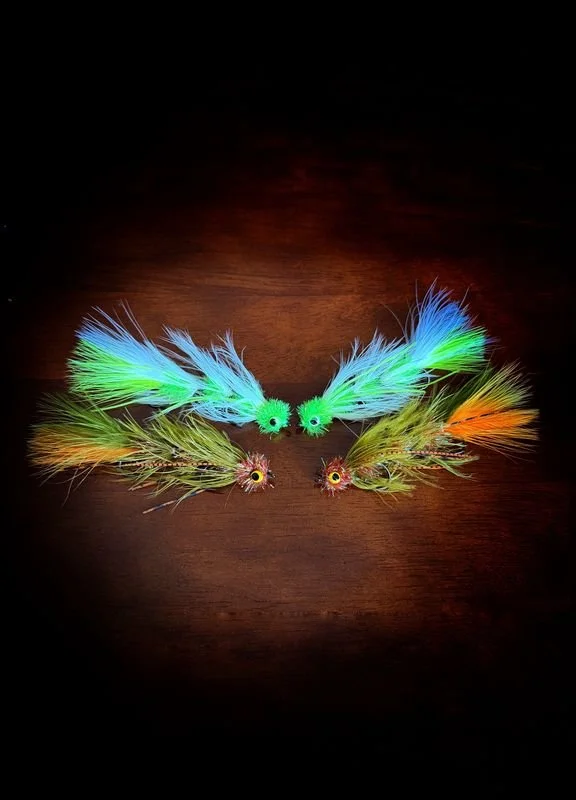
Most of Maddin’s Michigan fishing is done in very clear water, where visibility isn’t a huge issue. Thus, he incorporates lots of natural tones like brown, olive, tan, and black into his flies. Mixing and matching a variety of materials, even when not completely necessary for the pattern, helps him create mottled flies with contrast. He’s a big believer in matching fly color to that of the river bottom, noting that this tactic catches fish anywhere in the world. He does, however, occasionally utilize brighter colors at the heads of some of his steelhead-specific peanuts. Steelhead flies of all varieties, eggs, nymphs, swing flies, and streamers, often incorporate bright colors like yellow, orange, pink, and chartreuse to help fish detect them. Thus, throwing in some brightly colored laser dub at the head of a circus peanut is certainly worthwhile, especially if an angler’s water has some stain to it. Contrast, after all, is critical when visibility is low.
Putting it all Together
The Circus Peanut, in any format, is a blast to fish no matter what species you’re targeting. It’s unique blend of versatility, simplicity, and efficacy make it one of the world’s most imitated and adapted fly patterns. Anglers looking to hook into Great Lakes steel would do well to heed Maddin’s advice and carry a handful of purpose-built peanuts with them on the water to increase their odds of success.